DIY guide for a standing-seam steel roof with a parapet – part 1

Written by brad on September 4th, 2009

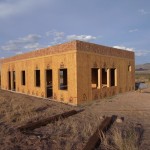
Karen and I finished our roof the other day. We’re really happy with it, but it was a lot of work. Nothing was too hard from a technical standpoint; I think it may have been all the trips up and down the ladder and the lifting, pulling, and carrying.

I think we took enough pictures to create a decent guide for others attempting a similar feat. We will see…

We originally planned on a membrane roof. We couldn’t find any installers willing to put one up for us… for a reasonable price. Seems odd. As it turns out, I think we were lucky.

On the way to the post office one day, I stopped in to introduce myself to a local artist – Roger McKasson. (Karen has emailed him before we moved here to see if he had a recommendation on an architect.) We got to talking and I mentioned the problem finding a roofer. He told me that he put on his own roof. He said he used an outfit from Silver City called Mastercraft Metals. He said they came out to his place and cut the roof to fit. He also said they told him how to install it and even lent him the tools to do the job. He said that he and his wife did the job themselves. It sounded too easy. I was intrigued.

I called Mastercraft and they confirmed Roger’s story. Then they quoted the job at a quarter the price of the membrane roof… assuming any one would install a membrane roof in Portal. Ha! (To be fair, in an apples to apples (installed) comparison, the price would have been half the price of a membrane roof.) Karen and I were pretty much on a path at this point.

The significant difference between the standing-seam steel roof (in my opinion) and a membrane roof is that the steel roof will not burn. The membrane roof people say it will not burn, but hot embers will burn holes through the material. Easily repaired I’m told, but better no holes at all. Another big difference for us is that you can install a standing-seam steel roof yourself – not the case with a membrane roof.

Picking a color… Karen and I did not spend a minute thinking about this. There’s been a lot of press regarding white roofs and global warming lately. Between the heat here, global warming and the solar tax credit for picking a white roof… well, you can guess what we did.

I’ve put up a few roofs before, and I always used tar paper under the roof. The people at Mastercraft Metals told me that these roofs last so long that a new kind of underlayment is needed. They recommended a product called Sharkskin-Ultra. I have to say I love the product. One big concern out here is the wind. I heard one apocryphal story about a guy who put tar paper on his roof four times before the roof was finished; each time a wind came up and ripped off the tar paper. It’s believable.

This Sharkskin stuff is tough. You can’t tear it. The wind never ripped so much as a single hole through a nail. Also, it claims not to change size when the temperature changes. I have to say my observations agree. (Doesn’t this violate some law of nature?) It was very easy to install. Basically, we chalked lines, rolled out a few feet at a time, nailed, repeat, repeat, repeat. The most difficult part for me turned out to be trivial for Karen. The last piece needed to be folded so as to go up the front and side parapet walls. I studied it; I cut pieces to try; nothing but a big angry mess. Karen got up to help me and in a few seconds she had made perfect corners. I still don’t know how she did it, but I quickly nailed them down.

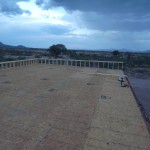
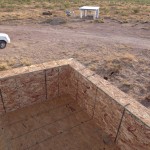
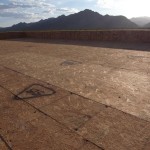
Our underlayment installed

Our underlayment installed

On the appointed day, Floyd from MasterCraft showed up in a big pickup truck pulling a trailer with the equipment to turn a roll of flat steel into the panels for a standing-seam roof. He also brought premanufactured trim pieces and an assortment of goodies to help complete the job.

Mastercarft Metals truck and trailer

Mastercarft Metals truck and trailer

A long table is needed to keep the panels from bending

A long table is needed to keep the panels from bending

A panel being formed

A panel being formed

Look at those choppers!

Look at those choppers!

Once Floyd had everything set up, he started making panels. As each one finished, we carried them into our house where we laid them in two piles.

Our temporary workshop

Our temporary workshop

It turned out to be ideal working on these in the house. (Karen wasn’t thrilled with how dirty the floor got, but afterward, it all cleaned up like new.) There is a fair amount of preparation needed, and it’s hot outside.  A table would have been nice. We worked on 2×6’s on their side. It worked fine, but there was a lot of crouching.

After all the panels were made and put away, Floyd gave us instructions on how to install the roof. He cut several small pieces of panel to help with the instruction as well as to be a concrete example for later when we would be on our own. Although everything seemed clear and easy when Floyd explained it, a few days later, things were a bit foggy. Between Karen and I, a few calls, and a little trial and error, all went well… quite well. We would encourage anyone to install their own metal roof. We hope this guide helps. Stay tuned for part 2 with more details.


Everything doesn’t always go well

Written by karen on September 2nd, 2009

A lot of things are going very well with our building project, and these are the things I normally write about. Not everything goes well though. I seldom write about the things that go badly, because, well, they’re not that fun to talk about.

Today, I’ll write about a bad day. Our new slab has begun to be framed, and it’s the first time we’ve really seen exactly where the house will go. Yesterday, after it was framed, I suggested we measure the distance from the house to the property line. (We’d approximately that for the site map, but I was never confident about the measurement.) So we got out the tape and measured. It was just under 60 feet. In looking at our approved site map, the distance was 123 feet. Not even close. And right under that was a stamp that said any proposed deviation from the plan must be approved in writing BEFORE construction starts.

OK.

We weren’t sure what code for the setback was, so we called the planning department. The person we wanted to talk to wasn’t answering and after a few messages and no information, we got gradually more and more concerned. And the slab work was continuing as we stewed about it.

To get our mind off this, we decided to start the house wrap. This involves putting large sheets of black two ply paper onto the house and nailing it down to weatherproof it before stucco’ing. I had heard good things about Tyvek, but we had a strong recommendation that everyone uses Jumbo Tex now, so we got a few rolls to try it.

The rolls are rather unwieldly. Trying to unroll it while nailing it down evenly wasn’t easy. It’s hard to roll out, moves around a lot, and gets all kinds of folds and wrinkles. And, like tar paper, Jumbo Tex rips very easily. After we got about a third of the way across the first row of the house, the wind came up, making this a virtually impossible task. We both got frustrated and ended up ripping down a huge sheet of Jumbo Tex and throwing it in the trash. We look at each other with exasperation and decided to go home and call it a day.

As soon as we got home, I looked up the code on the setback and found out it is 20 feet. That was a relief (especially because there really aren’t many options on where to put our main house, not to mention the amount of work that has already been done and the fact that I’d pretty much rather die than go back to redrawing the plans). Brad called the planning department to see if we needed to resubmit the site map and they said don’t worry about it. (In analyzing how this all happened, Brad had drawn his own site map initially, which had the right measurements. But when he went to the planning department, they wanted to just amend the old one Dan had done. Apparently, in that process, the clerk at the office wrote the wrong number in the wrong place.)

Today, we tried again on the Jumbo Tex. Both of us felt more positive this morning about how it would go, and in fact, it went just fine.

jumbotex

A lot of things are going very well with our building project, and these are the things I normally write about. Not everything goes well though, but I seldom write about hte bad things, because, wellk, they’re not that fun.

Today I’ll write about a bad day. Our new slab has begun to be framed, and it’s the first time we’ve really seen exactly where the house will go. Yesterday, after it was framed, I suggested we measure the distance from the house to the property line. (We’d tried to approximate that for the site map, but I was never confident about the meausrement, and the architect totally blew off helping wiht htat.) So we got out the tape vand measured. It was just under 60 feet. In looking at our approved site map, the measurement was 123 feet. Not even close. And right under that was a stamp that said any deviation from this approved plan must be approved in writing BEFORE construction starts.

OK.

We weren’t sure what code for the setback was, so we called the planning department. The person we wanted to talk to wasn’t answering and after a few messages and no information, we got gradually more concerned. And the slab work was continuing as we stewed about it.

To get our mind off this, we decided to start the house wrap. This involves putting large sheets of black of two ply paper onto the house to weatherproof it befiore stucco’ing. I had heard good things about Tyvek, but we had a strong recommendation that everyone uses Jumbo Tex now, so we got a few rolls to try it.

The rolls are rather unwieldly. Trying to unroll it while nailing it down evenly wasn’t easy. And, like tar paper, Jumbo Tex rips very easily. After we got about a third of the way across the first row of the house, the wind came up, making this a virtually impossible task. We both got frustrated and ended up ripping the huge sheet of Jumbo Tex we started on down and throwing it in the trash. We look at each other and decided to go home and call it a day.

As soon as we got home, I looked up the code on the setback which is 20 feet. That was a relief (especilly becuase there really aren’t many options on where to put our main house, not to mention the amount of work that has already been done and the fact that I’d pertty much rather die than go back to redrawing hte plans). Brad called hte planning department to see if we needed to resubmit hte site map and they siad don’t worry about it. (In analyzing how this all happened, Brad had drawn his own sitge map initially, but when he went ot hte planning department, they wanted to just ammend the old one Dan had doone. Apparently, in that process, the clerk at hte o0ffice wrote the wrong number in the wrong place.)

Today, we tried again on the Jumbo Tex. Both of us felt more positive about how it would go, and in fact, it went just fine.


Phase 2

Written by karen on August 31st, 2009

Today was a significant day — work began on the “main house.” (So far we’ve been working on Tumbleweed, the office/guest house.) We’ve contracted with someone to pour a new slab for the main house, and after being put off for a few weeks, work has now begun!

Today, the area was marked out and backhoe work commenced. This house will be perpendicular to Tumbleweed with a courtyard/patio between the two buildings.

backhoe

We also got two big truckloads of fill.

dumptruck

Work on phase 2 is significant to me for a couple reasons. First, it also includes pouring a slab for our battery house. This is a small 9×12 building that will go behind the storage container. It will hold our water pump as well as our solar batteries. Getting this done is  a key step in getting electricity and plumbing to both houses — a very important thing. (It will also provide another chance for me to practice my carpentry before we frame other walls.)

In addition, beginning on the main house is a tangible indication that we will actually  build a main house. That sounds obvious I know, but an amazing number of people we have met here had plans just like ours, build their “guest house,” moved into it (as we plan to), and then never built a “main house.”

I am here to tell you — we are building our main house. :)

We also made a big decision on the floors in the main house today. We had been planning to stamp the concrete. We had reservations about it though, ranging from the logistical difficulties in renting the stamp sets multiple times (or the expense of buying them for one time use) to the uncertainty about how stamped concrete would look indoors. We also really love our cut concrete floors in Tumbleweed. Today we decided to go with the same approach in the main house. We will, however, be using integral color (dye mixed into the concrete, so you don’t have to worry about the stain wearing off over time, which apparently it does). I am planning to use a light color though, so that we can surface stain a room or two in a different color.


Now, we just need knobs

Written by karen on August 29th, 2009

New steel double doors into the workshop are in.
IMG_5486


Woo-hoo!

Written by karen on August 27th, 2009

The roof is done!
R0011473


Unbelievably cute

Written by karen on August 26th, 2009

We’ve been putting up the metal roof this week. It’s incredibly hard work physically, and we both have been exhausted all week. Every muscle from my waist down hurts.

One thing that has made it easier though is the entertainment that the bobkittens are providing. All week, Momma bobcat has come by with the kittens mid-morning to drop them off in our oak tree while she presumably goes off to make a living. The kittens have been spending most of the days playing in the tree.

kittens

The kittens have very different personalities. One is very alert and cautious. He usually sits in the bottom most crook of the tree, always on the lookout. The other one could care less if we are around or not and seems only concerned with how comfortable she can make herself. She is frequently sprawled out on a high branch.

bobkitten2

This morning, I spotted one of the kittens on top of a big wood post by the gate. (The roof makes a great vantage point for watching their antics.) The next thing I know, the kittens are playing “King of the Hill,” chasing each other up and down the post. It was a scream.


Windows and doors are in

Written by karen on August 21st, 2009

The windows and doors are in (except for one window and one door that were not delivered with the rest), and they are beautiful. We spent a lot of time and had a fair amount of anxiety on the whole window thing and are really glad it all worked out!

house_w-windows

IMG_5446

Tilt-out casement windows

IMG_5444

Little 20×20 windows

IMG_5445

Resting after the work is done

IMG_5438


Final touches on the greenhouse

Written by karen on August 15th, 2009

But first… an update on Tumbleweed:

The Sharkskin paper is on the roof, and the final metal roof is arriving on Thurs. Because we went with the white roof, there’s a solar tax credit of $700.

The doors and windows are also due to arrive early this week.

—————————————-

Today, we put the final touches on the greenhouse.

The inside has a pathway of railroad ties and raised beds for plants.

The black hose is for the drip irrigation which isn’t quite finished.


More bobcat photos

Written by brad on August 12th, 2009

A lot of animals this morning. There were cows all over the road this morning. It was a challenge getting past them. About ten minutes after I was on the property, they had a mini-stampede up the road and away. Curious, there were deer standing near the cows, but on our side of the fence. They ran way as soon as they saw me.

The bobcats were all on the property today. When I drove up, one was inside the wire protecting one of our trees. It quickly scampered up a small mesquite tree. The other kitten ran off into the brush looking just like a kid off to fetch mom… sure enough, mom and the kitten wandered back about five minutes later.

I noticed the kitten in the tree had a small animal in its mouth; a bunny I think. It was small enough that I believe it caught it itself. On thing that dawned on me is that the bunny escape holes probably keep mom out, but these not these kittens. -sigh- It’s a hard world.


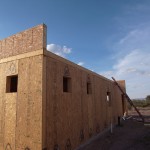
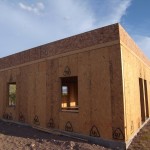
Parapet walls finished-we’re moving on

Written by brad on August 10th, 2009

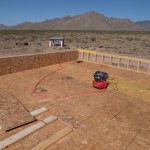
Building the parapet walls has been fun and not too challenging. The biggest concern was getting them attached in such a way that they won’t blow away later. The winds here can be intense.

Framing

The only issue with the framing was on the slope walls. You need to keep it straight in your mind that the studs run perpendicular to the top, not the bottom; it’s on a slope. On a slope this small, it’s seems unimportant, but when you go to attach the OSB, you won’t end cleanly on a stud if you do it wrong.

Erecting and Attaching

Standing up the walls and positioning them was easy. (2×6 walls are night-and-day easier than 2×4 walls in this regard.) Screwing down the walls was a little harder. We used ten inch long screws that go clear through the SIPS panels and into the 2×6 header on top of the walls. Karen pre-drilled holes for me. We have what I thought was a pretty big drill to do the job and it barely did the job. We had more than enough screws and used them all. I also had a lot of extra eight inch screws that I set into the 2×6’s framed into the sides of the roof SIPs. It’s very sturdy.

Covering

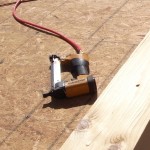
The whole thing was covered in OSB*. This went fast. A large part of the reason it went fast is that we are the proud owners of a used Bostitch stapler. (Putting up our SIPs walls resulted in our having a box of 1/2 inch wide by two inches long staples seven-eights full–ebay to the rescue.) The stapler made short work of attaching the OSB to the walls. (Karen did most of the stapling.) Cutting the OSB to fit was the most work.

One special touch designed to prevent leaking is that we put a one-half inch in six inches slope on top of the parapet walls. Six inches is not a lot of room for standing water, but we’re just making sure.

* Oriented Strand Board: A decking made from wood chips and lamination glues.